Seven Sisters Tour

Description
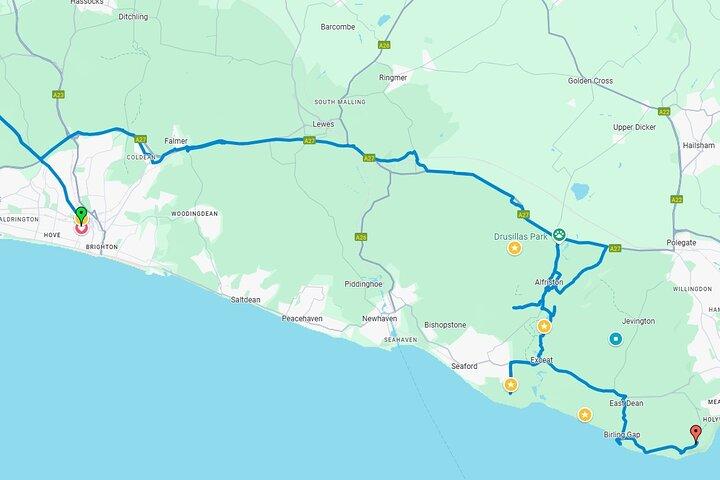
Firstly please note this tour is able to be changed, that means if you want a shorter or longer version of the tour I can do that for you. This area of England impressed me so much that I wanted to show others what is has offer and only 25 mins drive from Brighton. This tour has flexibility and a relaxed feel about it and will be a day where you can unwind and enjoy being driven to all the hidden spots on the coast that other tours wont venture. Touring in Mercedes Luxury 7 seater mini bus and being picked up from your hotel, Airbnbor Brighton Station. Small easy-going Tour that can be changed on route to suit your needs if required. Having the smaller bus we are able to venture into the narrow roads in the villages of the South Downs. Note: London travellers will be picked up from Brighton train station. Note: Single Travellers please contact me for special booking requirements as we may be able to accommodate a single person booking. I want this day to be rememberable for you.
Tour Options
Itinerary
Devil's Dyke is a 100-metre (330 ft) deep V-shaped dry valley . We stop here and go walking around the top of Devils Dyke and talk about the history Devil's Dyke when it was a huge attraction for the Victorians in mid 1800s. How was it formed? The Devil's Dyke V-shaped dry valley is the result of solifluction and river erosion. More than 14,000 years ago[unreliable source?], the area experienced an intensely cold climate (but not glacial conditions). Snowfields capped the South Downs. Permafrost conditions meant that the chalk was permanently frozen. In summer, the snowfields melted and saturated the top layer of soil, because the water could not permeate the frozen chalk underneath. Waterlogged material situated above the permafrost slid down the gradient, removing material by friction, exposing deeper layers of frozen chalk. When the Ice Age ended, the snowfields covering the South Downs melted, and rivers formed across Sussex. The Devil's Dyke valley was completed by one such river
Seaford Beach in East Sussex has a long history of coastal challenges, particularly due to the natural movement of shingle along the shoreline. This constant shifting has necessitated ongoing human intervention to maintain the beach's integrity and protect the town from erosion and flooding. In modern times, heavy machinery such as bulldozers and dumper trucks have been employed to manage the beach's shingle. These vehicles are used to redistribute the pebbles, especially around structures like the Terminal Groyne, to counteract the effects of longshore drift and ensure the beach remains a viable sea defense
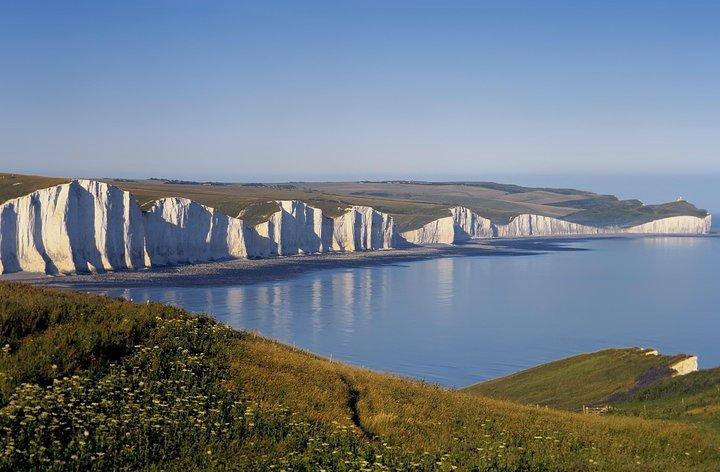
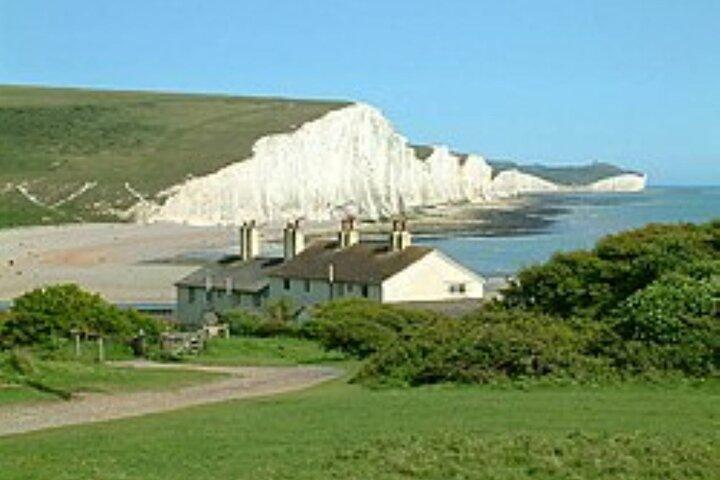
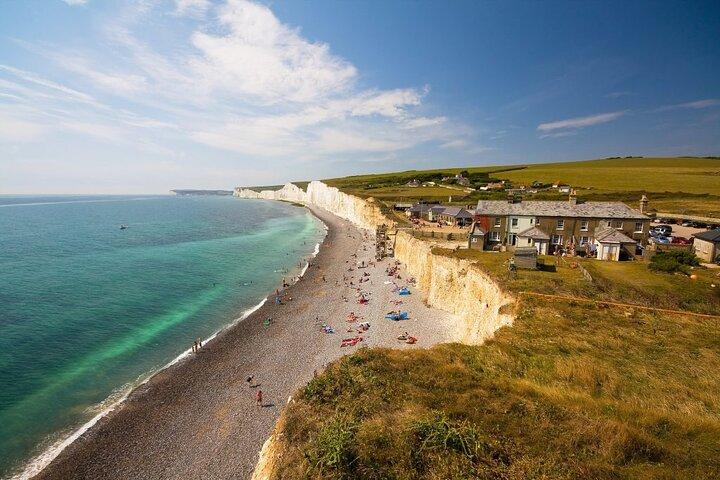
Seven Sisters best view point is a short 10 mins walk away from where we park. The walk is completely optional. View the scenic Seven Sisters Cliffs from Seaford Head Nature park - It stands on one side of one of the last remaining undeveloped river mouths on the South Coast, Cuckmere Estuary. It is home to many nationally rare and significant species of plant, birds and insect, providing visitors with a great conservation experience, together with peaceful walks with the world-renowned view of the Coastguard Cottages, Seven Sisters Cliffs and the Cuckmere River Valley. Cable House 14 Hidden alongside the newly named route, ' The King Charles III England Coastal Path', is Cable House 14. This intriguing hut is the birthplace of a network of undersea cable stations that connect the world. Built in 1900 as a relay station to carry telegraph messages under the sea to France, the hut was converted to a gun emplacement in WWII to fend off a landing invasion at Cuckmere Haven.
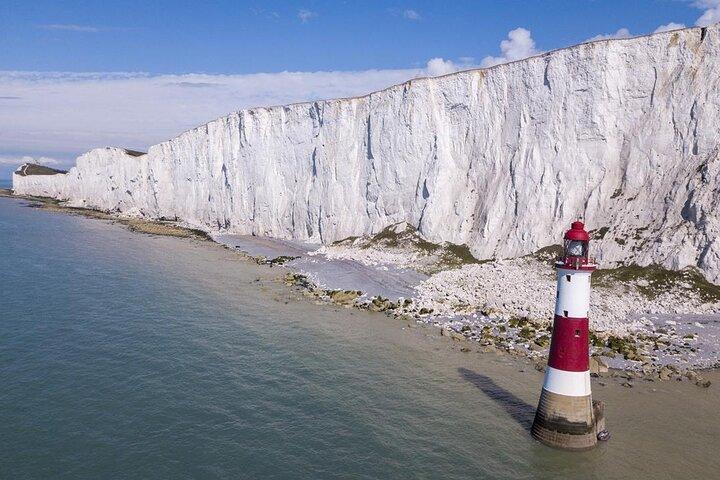
We drive the the coast road down to Birling gap. I recommend that you walk from the lighthouse down along the cliffs to Birling Gap (20mins) this is optional if you feel like it. The Belle Tout Lighthouse came into operation on the 11th October 1834 and was manned around the clock by two lighthouse keepers. The location of the lighthouse was carefully planned so that the light was visible for 20 miles out to sea and that the light would be obscured by the edge of the cliff if sailors were too close to the shore. However being on top of the cliffs was prone to be in the cloud, so ceased in 1900 and Beachy Head lighthouse took over.
There is a option here to have lunch at the Tiger Inn East in East Dean Village. This is a pub where the Smugglers used to meet. East Dean Village is centred around the Village Green with its war memorial, mediaeval church and long-established inn, “The Tiger”. Tiger Inn: (Optional)has been serving fine ales, wines and food to surrounding residents, farmers, soldiers, walkers, smugglers, lovers and brewers since the 15th century. We stop here if you would like to have a hearty country pub lunch or just a quick drink.
Local Beer Brewery and cafe (Optional)
View the Seven Sister Cliffs from Sea Level, walk the beach and get some great pictures. Stop for a snack or drink at the visitors centre.
Yew tree, estimated to be 1600 years old Wilmington is a Downland village of Saxon origin, the present church was first built around 1200 as a chapel to the adjacent Priory and a feature of the churchyard is the ancient Yew tree, estimated to be 1600 years old, the trunk having a girth of 23ft. Dont eat the red berries as they are poison!!! You can eat the berry but not he pip.
Charming church in a peaceful rural setting, with a history dating back to the 13th century. A larger church once stood on the site, but was replaced by the current building after being destroyed by fire. This tiny church is one of the smallest in England, and the smallest in Sussex. The churchyard enjoys lovely views of the surrounding countryside, and the church is open daily. There's no on-site parking but the walk from Alfriston takes about 15-20 minutes.
This is an option to stop here for complimentary Tasting in the cellar door shop if this is something you would like then we do it. Dedicated to producing some of the world’s finest English sparkling wines from a single-site Sussex Vineyard. Located on a wonderful south-facing slope in England’s South Downs, the climate, chalk soil and aspect make it the perfect UK Vineyard for producing Sussex Sparkling wine
About The Long Man of Wilmington The Long Man of Wilmington – or the Wilmington Giant as he’s sometimes known – stands on the steep slopes of Windover Hill above the village of Wilmington. The origins and meaning of the figure have long since baffled archaeologists and historians for hundreds of years. Is the figure a fertility symbol, ancient warrior or an 18th century folly? We may never know for sure. It’s difficult to date this giant There are a number of theories about the date of the figure. Some are convinced that he’s prehistoric. Roman coins with a similar figure lead others to think he dates from the 4th or 5th centuries. An Anglo-Saxon origin has also been suggested, as there are parallels with a helmeted figure found on ornaments from that period. Or perhaps the Long Man is the work of an artistic monk from the nearby Wilmington Priory sometime between the 11th – 15th centuries.
Founded in the 1360s, St Andrew’s is a fine example of a 14th century parish church, located close to the winding Cuckmere River, and beside the Old Clergy House (the first National Trust property). Built with all the loving care of the craftsmen of that age, it is unlike many other churches, because it was built all at one time with no major later additions. Its size and soaring arches (together with few memorials in the interior, creating a spacious and open feel), make it stand out from many local churches, and it has become known as the “Cathedral of the South Downs”. Six bells are placed below the spire, and for this reason the church is one of less than twenty in the country where bell ringers regularly (and dramatically) ring from the centre of the church.
Stop for Sightseeing around the village
Set in the charming Medieval village of Alfriston, East Sussex, our two-floor shop features new books alongside vintage, antiquarian and secondhand volumes. Formerly a builders' yard, the compound boasts a book-filled shepherd's hut and a bower bursting with bargain paperbacks.
First licensed in 1397, the foundations of this splendid flint stone and half-timbered building date back to 1250, and there is a network of smugglers' tunnels leading from its cellars. The bar, the oldest part of the inn, has an impressive inglenook fireplace with a huge copper hood, oak floors and Sussex hop bines decorating the walls. To the rear is the large garden and a heated terrace for those cooler evenings. Good quality food is served here.
Highlights
What's included
Pickup Locations & Times
Note: for people travelling from London by train I will pick you up from the train station. We can meet at your hotel reception area or outside the Brighton Train Station Entrance.
Traveller Ratings
Important Information
- Specialized infant seats are available
- Service animals allowed
- Public transportation options are available nearby
- Infants and small children can ride in a pram or stroller
- Suitable for all physical fitness levels
Reviews(10)
Colin is a fabulous guide. He is flexible with your schedule and interests and strives to make it a great day seeing all the sights in the area highly recommend .
Absolutely brilliant tour if you’re looking to see as much as possible in a short amount of time. Colin was a great guide and will take you to places you would never have even considered. Would definitely recommend.
Thank you :-)
Colin was freaking awesome! He is so fun and really funny guy! On our hike we even ate wild berries which were delightful! He also does mountain biking tours which I would 100% come back and book with him during the summer. We stopped at an amazing local pub and really got a feel for this part of England! I would definitely recommend this tour for anyone considering it.
This trip is a “must do” in Brighton. We had the best guide, Collin. He went out of his way to make sure we were comfortable, told us fun stories and history of the area, and made sure we all had the best day. Highly recommend both our guide and this tour!
Great tour! Customizable. Colin is a great guide and a perfect host. It was like being driven around by your long lost cousin who is truly excited to show you around. Good balance of walking and driving. Multiple angles of seeing the Seven Sisters. Highly recommend this tour.
Colin was delightful and took us to all the special places in Sussex, including 7 Sisters, pubs, historic sites and geologic wonders. It was blustery day, but Colin found us great spots for viewing and walking. A truly perfect outing!
Colin was a perfect guide on this private day tour who showed us the best spots and places. Water and sweets were included on the ride, and we learned a lot of interesting things. Pickup and organization were quite problem-free, and it couldn't have been better!
Great tour of Sussex. Colin picked out the most charming villages and churches to see, along with the cliffs of seven sisters. Beautiful spots to walk along and photograph. Also visited a 1,700 yr old Yew tree, saw the historic chalk long man and the chalk horse in the hill. He knew all the most quaint and charming places to go. Gave the history along the way. Lovely drive through the country side
Our our guide, Colin was on time and conveniently parked next to Brighton Station. He was knowledgeable, patient, helpful, friendly, and compassionate. He made our tour unforgettable and we would highly recommend him and this tour to others. Thank you Colin. You are a legend