Tour en tuk-tuk electrico por MADRID MODERNO
Description
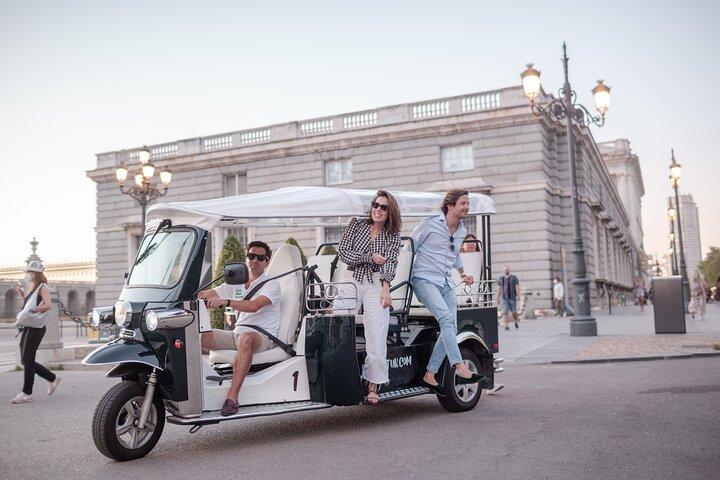
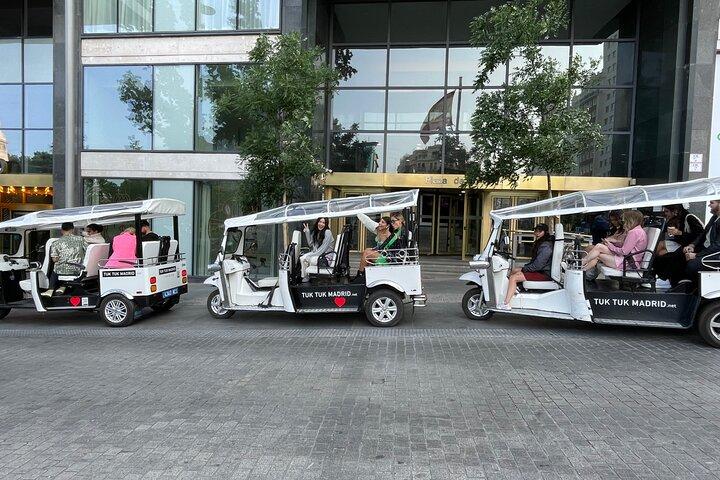
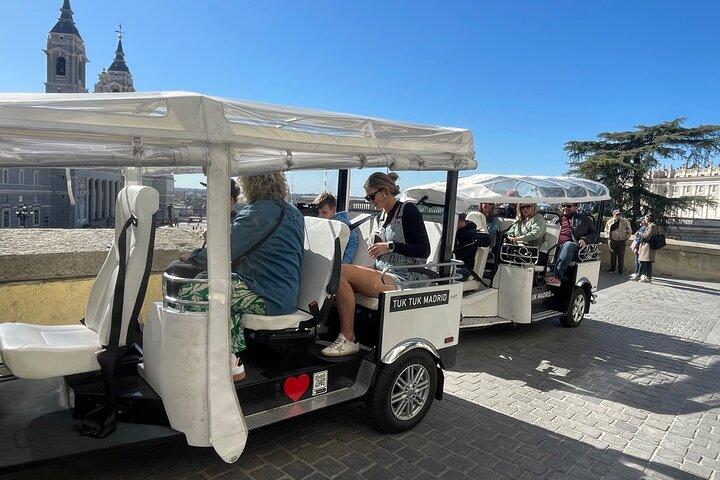
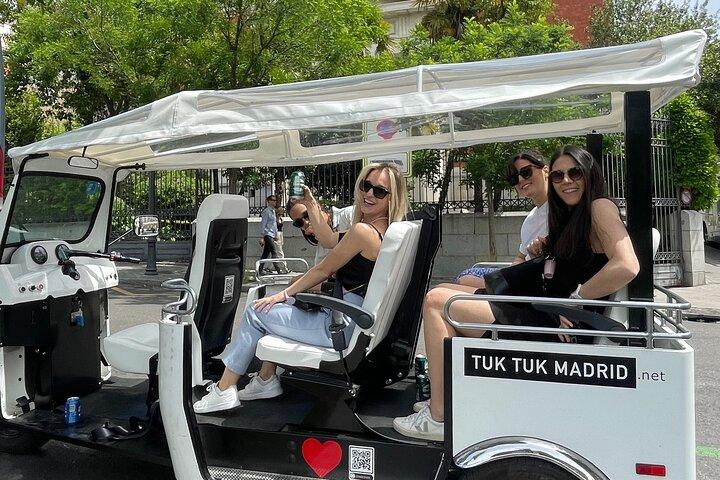
Kairos tuk-tuk takes you 120 minutes through the most desired Madrid, Modern Madrid. The most relevant area of the city composed of its large avenues and emblematic buildings, a combination of Baroque and Neoclassical architecture. discover the avenida de la castellana and the Salamanca district (in the most glamorous area of the city) that since the 19th century has housed the aristocratic and bourgeois classes where diplomatic, business and luxury shopping activities coexist. We are pleased with your visit to Madrid, and we will make your experience unforgettable. !!! We comply with the measures for the reduction of contagion by the health COVID19 of Spain for Guide and means of transport.
Tour Options
Itinerary
The Royal Palace of Madrid, also called the Royal Palace of the East, is the official residence of the King of Spain; With an area of 135,000 m² and 3,418 rooms, (almost double that of Buckingham Palace or the Palace of Versailles), it is the largest royal palace in Western Europe. our guide will give you details of this emblematic place.
The Santa Iglesia Catedral Metropolitana de Santa María la Real de la Almudena, known simply as the Almudena Cathedral, is a cathedral of Catholic worship, dedicated to the Virgin Mary under the invocation of the Almudena, and the episcopal headquarters of Madrid. Built on the site of an old mosque, Almudena Cathedral takes its name from the Arabic word al-mudayna, which means "citadel". The cathedral is located in the historic center of the city of Madrid. The cathedral is the main temple of the Archdiocese of Madrid, seat of the archbishop and the metropolitan chapter. It is a building 102 meters long and 73 meters high, built from the end of the 19th century to the end of the 20th, in different architectural styles: Neoclassical on the outside, Neo-Gothic on the inside and Neo-Romanesque in the crypt
The Royal Basilica of San Francisco el Grande, officially Basilica of Our Lady of the Angels, is a Catholic church in Madrid, in the Palacio neighborhood, within the historic center of the capital of Spain. It presides over the western face of the Plaza de San Francisco, configured by the intersection of Calle Bailén and Carrera de San Francisco. It is part of the Franciscan convent of Jesus and Mary, founded at the beginning of the 13th century, on a defunct hermitage dedicated to Saint Mary.
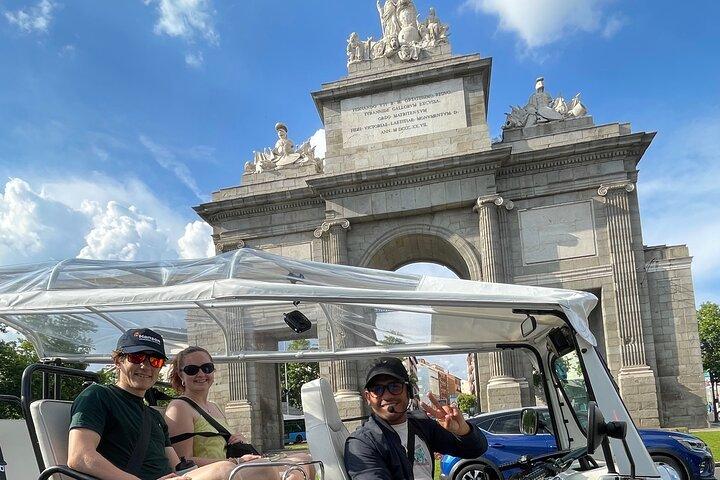
The Toledo gate was one of the access gates to the city of Madrid. There were previously three other gates called Toledo in the vicinity, the current one dates from the first third of the 19th century and was designed by the Spanish architect Antonio Aguado, which is located in the middle of the Glorieta de la Puerta de Toledo as a roundabout . It was erected as a triumphal arch in honor of King Ferdinand VII as a commemoration of Spanish independence after the French occupation.
The Neptune Fountain is a neoclassical fountain that occupies the center of the roundabout to which it popularly gives its name, within the Plaza de Cánovas del Castillo, in the Spanish city of Madrid. This monumental fountain was proposed in 1777 and its construction, begun in 1782, ended in 1786. Originally it was located at the descent of the San Jerónimo race, facing the Cibeles fountain, but it was moved to the center of the aforementioned square. in 1898.
The Atocha station is a railway complex located near the Plaza del Emperador Carlos V, in Madrid, Spain. It acts as a railway junction, and this makes it the station with the highest passenger traffic in the country. The station arises as a simple halt (inaugurated in 1851), which is extended to become the Midi station (inaugurated in 1892)
The Museo Nacional Centro de Arte Reina Sofía (MNCARS), commonly known as Museo Reina Sofía, is a Spanish museum of 20th century and contemporary art, based in the city of Madrid. It took as its headquarters the old General Hospital of Madrid, a large neoclassical building from the 18th century located in the Atocha area, near the train station of the same name and the Metro Station of Art. This hospital was initially designed by José de Hermosilla and later continued by Francesco Sabatini, and is currently known as the Sabatini building in honor of this Italian architect. The museum as such was inaugurated in 1992, although the building had already housed temporary exhibitions in previous years. In September 2005, the institution's facilities were expanded with the opening of the Nouvel building at the beginning of the Ronda de Atocha.
The old monastery of San Jerónimo el Real, popularly known as "Los Jerónimos", was one of the most important monasteries in Madrid, originally ruled by the Order of San Jerónimo. Next to it there was the so-called Royal Room, later expanded as the Buen Retiro Palace in the times of Felipe IV.
The Casón del Buen Retiro is one of the only two buildings that have survived the destruction of the Buen Retiro Palace, from which it takes its name, in Madrid (Spain). Built by Alonso Carbonel in 1637, it was initially designed as a space for the ballroom of the Court of Felipe IV. Since 1971 it has been one of the buildings that make up the Prado Museum, and for decades it has housed its collections of 19th century paintings (about 3,000 paintings), as well as Pablo Picasso's Guernica. This famous painting was moved to the Reina Sofía Museum in 1992, and the Casón, after years of work, was reopened as a Museum Study Center in 2009, while the 19th century collections have been relocated to the Prado's main headquarters thanks to the expansion of Rafael Moneo.
The Salón de Reinos or large room was the authentic representative axis of the old Buen Retiro Palace in Madrid, built between 1630 and 1635, and the one that housed the best paintings, almost all now preserved in the Prado Museum. The room owes its name to the fact that the coats of arms of the twenty-four kingdoms that formed the Hispanic Monarchy in the time of Philip IV were painted on it. However, its most popular current name is the Army Museum, because it housed this institution between 1841 and 2005, when the transfer of its collections to the Alcázar of Toledo began. Along with the Casón del Buen Retiro.
The Royal Spanish Academy (RAE) is a publicly funded private Spanish cultural institution based in Madrid, Spain. This and twenty-three other language academies corresponding to each of the countries where Spanish is spoken make up the Association of Spanish Language Academies (ASALE). It was founded in 1713 on the initiative of the enlightened Juan Manuel Fernández Pacheco, VIII Marquis of Villena and Duke of Escalona, in imitation of the French Academy. The following year, King Felipe V approved its constitution and placed it under his protection.In 1715, the Academy approved its first statutes.
The Museo Nacional del Prado, in Madrid, Spain, is one of the most important in the world, as well as one of the most visited (the eighteenth in 2013 among art museums), and is considered the most important cultural institution in Spain, according to the 2020 Culture Observatory, a study carried out among several hundred professionals in the sector. Uniquely rich in paintings by Spanish and European masters from the 15th to the 18th centuries, and Spanish from the 19th Its main attraction lies in the wide presence of Velázquez, El Greco, Goya (the artist most widely represented in the museum), Titian, Rubens and Bosco, of which it has the best and most extensive collections that exist worldwide.
The Puerta de Alcalá is one of the five old royal gates that gave access to the city of Madrid (Spain). It is located in the center of the roundabout of the Plaza de la Independencia. At the crossroads of Alcalá, Alfonso XII, Serrano and Salustiano Olózaga streets, next to the Retiro gates: Puerta de España, Puerta de la Independencia (main entrance to the Retiro gardens) and Puerta de Hernani.
The Las Ventas bullring in Madrid is the largest bullring in Spain. With 23,798 spectators, it is the third largest bullring in the world, after those in Mexico and Valencia (Venezuela). It is also the second largest in terms of the diameter of its ring -61.5 m- after that of Round.
The Salamanca district is one of the 21 districts that make up the municipality of Madrid (Spain). It owes its name to its builder, the Malaga-born José de Salamanca y Mayol, Marquis of Salamanca, who promoted and built it in part in the 19th century. It has become one of the most important commercial areas of the city and one of the districts with the highest standard of living in Europe with the largest luxury shopping area in Madrid around Serrano, Claudio Coello and Ortega y Gasset streets.
The Plaza de Colón is a public space in the Spanish city of Madrid, where streets such as Goya, Génova and the Paseo de la Castellana and Recoletos converge. It receives its name from Christopher Columbus. It is bounded by the streets of Serrano, Goya, Jorge Juan, and the Paseo de Recoletos and La Castellana, joining the latter two with Calle de Génova. In it there is a monument to Christopher Columbus in the neo-Gothic style, erected between 1881 and 1885.
The National Library of Spain (BNE) is an autonomous body in charge of the deposit of the bibliographic and documentary heritage of Spain. Dedicated to gathering, cataloging and preserving bibliographic funds, it guards around thirty million publications produced in the national territory since the beginning of the 18th century: books, magazines, maps, engravings, drawings, scores and brochures.
The Cibeles fountain (better known to locals as La Cibeles) is a monumental fountain in the city of Madrid, located in the square of the same name, in the center of the Spanish capital. It was conceived within an urban remodeling plan in the 18th century, at the initiative of King Carlos III, who planned to beautify the capital of the kingdom according to the aesthetics of neoclassicism. The project included a series of sculpted fountains with classic mythological motifs (Fountain of Neptune, Fountain of Apollo), a Natural Science Museum (now the Prado Museum), the Royal Botanical Garden, the landscaping of the area and other proposals that finally did not materialized. Due to the beauty and amenity of the place once it was finished, it was known among the people of Madrid as "Salón del Prado", and it immediately became one of the most popular places in the city.
The Bank of Spain is the central bank of Spain. Founded in Madrid in 1782 by Carlos III, today the bank is a member of the European System of Central Banks and is also the competent national authority in Spain for banking supervision within the Single Supervisory Mechanism. Its activity is regulated by the Autonomy Law of the Bank of Spain. Its main headquarters, built between 1884 and 1891, is located at the confluence of Calle Alcalá with Paseo del Prado, overlooking the Plaza de Cibeles. In the capital it also has another headquarters at 522 Calle Alcalá and fifteen branches spread throughout the national territory.
Gran Vía is one of the main streets in the Spanish city of Madrid. It begins in Calle de Alcalá and ends in Plaza de España. It is an important landmark in the city since its construction at the beginning of the 20th century seen from a commercial, tourist and leisure point of view. In this last aspect, it is famous for its cinemas, although in recent years some of them have closed and others have been converted to musical theater, which is why the section between the Plaza de Callao and Plaza de España is known as the « Madrid's Broadway ». The section between the San Luis network and the Plaza de Callao currently houses numerous international fashion chain stores.
Highlights
What's included
Traveller Ratings
Important Information
- Infants and small children can ride in a pram or stroller
- Service animals allowed
- Public transportation options are available nearby
- Specialized infant seats are available
- Suitable for all physical fitness levels
- Customers have the option of stopping at each attraction just to take pictures and will hear a brief historical information about each monument.
Reviews(62)
Cesar was great, he was funny and informative. I added to my list of things to see before I left Madrid. We had a great time. We stopped to take pictures in the most amazing views. Highly recommend !
Great! Nice tour done and also got a lot of info from the sympathetic Drivers ( Ernesto and his partner) Definitely worth doing!
Antonio, Abel and Enrique, excellent people, very friendly and helpful. They were very attentive and diligent. 100% recommended.
Fun way to see the city in a short time. Not usually our way but tried something new and really enjoyed! Our guide Gabriel was so nice and knew everything about Madrid’s history.
Excellent tour of the old part of the city of Madrid that was the one we chose, we were touched by the super friendly, friendly and very professional Gabriel driver guide with a great knowledge of the history of the city. The tour is worth it, highly recommended.
Wonderful Experience!!! To know Madrid and its history differently. We were David’s turn as a driver, he taught us and explained the history of Madrid in a pleasant and fun way. I know from the beginning that you have a great knowledge of the history of Madrid and many curious anecdotes. 100% recommended!!!
The guide did not show up for our tour. Ridiculous. Viator was easy to deal with for the refund but it was very disappointing to have to take the time to download their app, explain what happened, explain it again, verify we're in the right place, wait while they try to get ahold of the guide, no answer...then wait for my refund. All at 9am.
Alberto is a local guide that was born and raised here in Madrid close to the central , he loves history and can speak 5 languages . If you need a cost effective tour for up to 5 people contact him on WhatsApp 34-628-83-15-39
We had a blast! The tour was very amusing and our tour guide Dora was the best! We even learned some interesting details from the city. It was a 10/10
The walk itself is fine, but the guides although very friendly do not have any training. It gives the feeling that they give you an accelerated course of what they have to say at each stop and little else. They are not prepared to answer questions and their explanations are so basic that they do not contribute anything.