Gyeongju UNESCO World Heritage Sites and History Full-Day Tour with Lunch
Description
During this comprehensive 8-hour small-group tour, your dedicated guide and driver will escort you through the historic city of Gyeongju, often referred to as “the museum without walls.” The itinerary includes visits to two UNESCO World Heritage Sites — Bulguksa Temple and Seokguram Grotto — where you will gain deeper insight into Korea’s rich Buddhist heritage and architectural achievements. In addition, the tour features several other culturally significant landmarks that highlight the city’s royal history and ancient Silla Dynasty culture. For your comfort and convenience, lunch, all entrance fees, and round-trip transportation are included in the tour package. Please note that a minimum of two participants is required for the tour to operate. If the minimum number is not met, the tour may be subject to cancellation.
Tour Options
Itinerary
Cheomseongdae is the oldest existing astronomical observatory in Asia. Constructed during the reign of Queen Seon-deok (632-647), it was used for observing the stars in order to forecast the weather. This stone structure is a beautiful combination of straight lines and curves, and was designated as National Treasure No.31 on December 20th, 1962. Cheomseongdae was built in a cylinder shape with stones 30cm in diameter. 362 stones were piled up to make 27 levels. Roughly 4.16m up from the bottom there is a 1㎡ square entrance and a space to hang a ladder under it. The inside is filled with soil up to the 12th level, and the 19th, 20th, 25th, and 26th levels all have long rocks hanging on two areas, shaped as the Chinese letter '井' (jeong). It stands 9.17m high and the base stone on each side measures 5.35m. The Vernal Equinox, Autumnal Equinox, Winter Solstice, Summer Solstice and the 24 solar terms (also known as the astronomical solar year) were determined by the observation of stars. The pavilion stone is believed to have been used as a standard of deciding directions, north, south, east and west. The 362 stones used to build Cheomseongdae represented the 362 days in a lunar year.
According to the historical records of Samguk-sagi, Wolji Pond was built during the 14th year of King Munmu (r. 661-681 AD) of the Silla Kingdom (57 BC-935 AD). Small mountains were created inside the palace walls, beautiful flowers were planted, and rare animals were brought in to create an exquisitely exotic garden fit for royalty. The pond was originally built in Wolseung Fortress (built in 101 AD during the Silla period), but the fortress was destroyed and now lies in ruins. In 1974, an excavation project revealed large spherical shapes (measuring 200 meters in diameter and 180 meters in height) which indicated that 3 islands had been located in the pond. Thanks to these important findings and existing historical records, Wolji Pond has been restored to nearly its former glory. Imhaejeonji As one of the detached palaces of the Silla royal family’s main palace, this structure was used as the crown prince’s palace. Imhaejeon is historically the most important building on the property and records often refer to the whole area as ‘Imhaejin.’ An excavation resulted in the discovery of several buildings: Hoerang (corridor area) and five towers in the western part of the area. Some sites have been restored while others have been left in their natural state with only the cornerstones poking out from beneath the ground.
Located in Gyeongju-si, Gyeongju Gyochon Village is a hanok village that allows visitors a look inside life of famous the Choi Clan. Visitors can see the House of the Gyeongju Choi Clan (Important Folklore Material No. 27) and try some Gyeongju Gyodong Beopju Liquor (Important Intangible Cultural Asset No. 86-3) inside the village.
Large ancient tombs of kings and nobles of the Silla Kingdom can be seen around Gyeongju at the Daereungwon Tomb Complex (Cheonmachong Tomb). There are twenty-three large tombs located here; the most famous being Cheonmachong and Hwangnamdaechong. In an excavation of the area in the 1970s, Cheonmachong was discovered with a painting of a mounted horse. This painting is the only discovered painting from the Silla era. You can also view the inside of Cheonmachong. There are 11,526 remains and royal crowns inside the tomb, demonstrating the lavish lifestyle of the king. Another tourist attraction is Hwangnamdaechong, the largest ancient tomb. It houses the bodies of both the king and queen and has over 30 thousand relics and gold accessories. The unique thing about Hwangnamdaechong is that the queen's tomb has more luxurious accessories. Researchers have concluded that even the queen can have a high social position before marriage. You can feel the ancient culture of Korea 1,500 years ago when visiting these tombs.
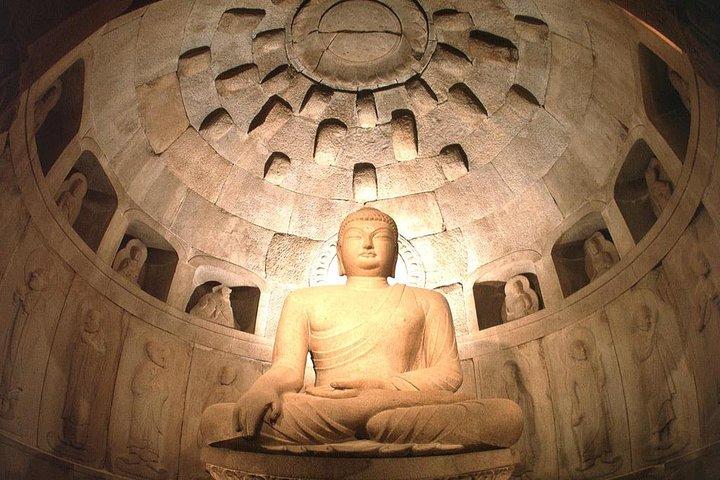
Seokguram, located on Tohamsan Mountain, is the representative stone temple of Korea. The official name of Seokguram, National Treasure No. 24, is Seokguram Seokgul. Designated as a World Cultural Heritage Site by UNESCO in 1995, it is an artificial stone temple made of granite. The construction was started by Kim Dae-Seong (700-774) in 751 during the reign of King Gyeong-Deok (742-765) of the Silla Kingdom (57 BC - AD 935) and it was finished twenty-four years later in 774, during the reign of King Hye-Gong (765-780). Seokguram is known to have been built with Bulguksa Temple. According to the history book Samgukyusa of the Goryeo Dynasty (the country that unified the Korean peninsula at the end of the Silla Kingdom, 918-1392), Kim Dae-Seong had Bulguksa Temple built for his parents in his current life, and Seokguram Grotto for the parents of his former life. Inside the round-shaped main hall are the Bonjon Statue, Bodhi-sattva and his disciples. The Bonjon figure wearing a generous smile is seated on the stage engraved with a lotus flower design. The rounded ceiling looks like a half-moon or a bow and has a lotus flower decorated cover on it. As the sunrise from this spot is quite beautiful, many people climb the mountain at daybreak.
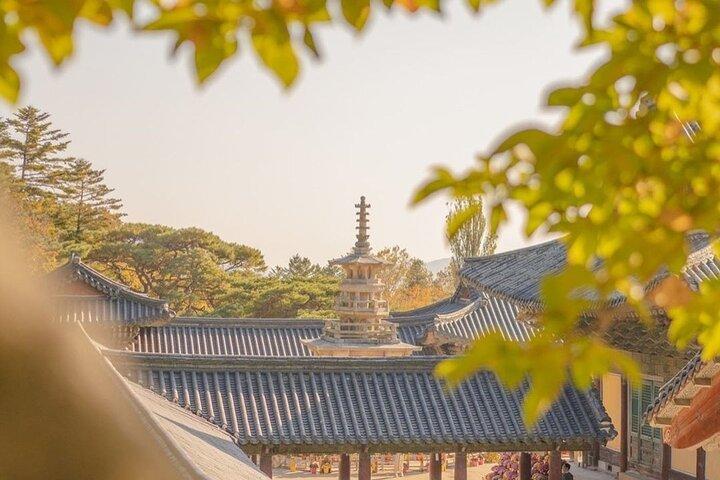
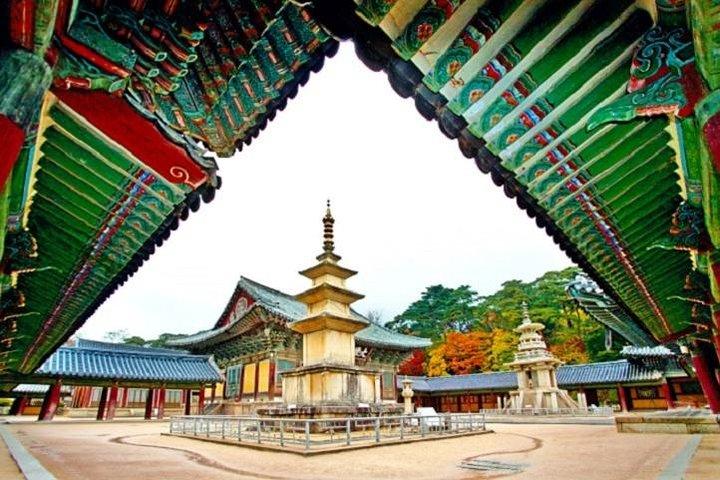
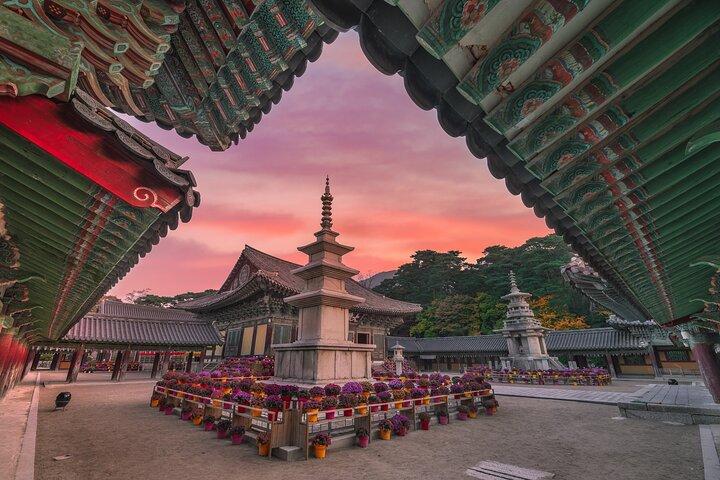
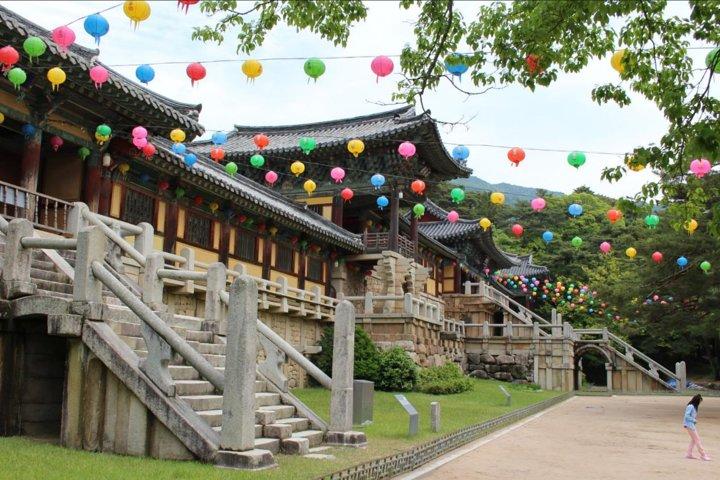
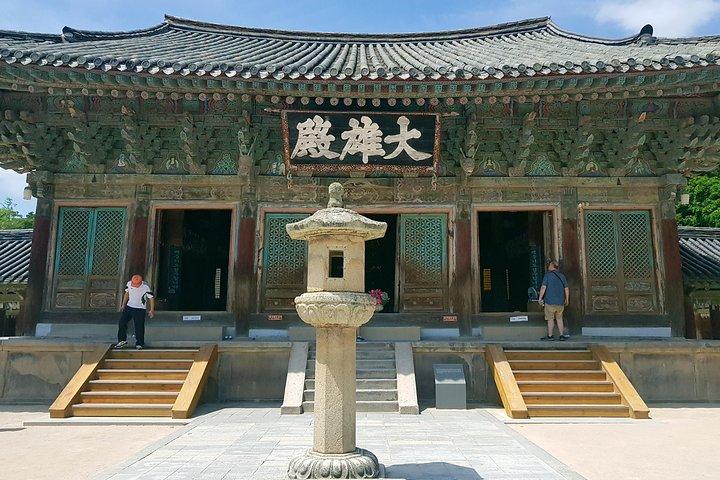
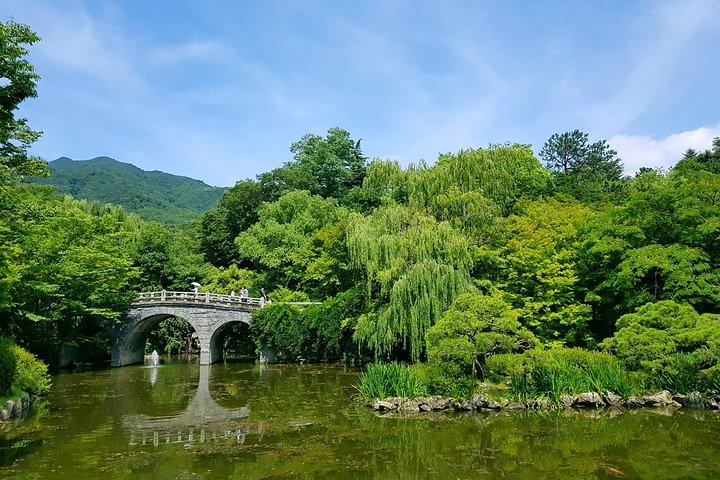
Bulguk Temple is the representative relic of Gyeongju and was designated as a World Cultural Asset by UNESCO in 1995. The beauty of the temple itself and the artistic touch of the stone relics are known throughout the world. Bulguk Temple was built in 528 during the Silla Kingdom, in the 15th year of King Beop-Heung's reign (514-540). The temple was originally called ‘Hwaeom Bulguksa Temple’ or ‘Beopryusa Temple’ and was rebuilt by Kim Dae-Seong (700-774), who started rebuilding the temple in 751 during the reign of King Gyeong-Deok (r. 742-765) and completed it in 774 during the reign of King Hye-Gong (r. 765-780). Upon completion, the temple’s name was changed to Bulguksa. Bulguk Temple underwent numerous renovations from the Goryeo Dynasty (918-1392) to the Joseon Dynasty (1392-1910), but was burned down during the Imjin War (Japanese Invasions, 1592-1598). Reconstruction started again in 1604 during the 37th year of King Seon-jo’s reign (Joseon Dynasty) and was renovated about 40 times until 1805 (during the reign of King Sun-Jo, 1790-1834). After this time, the temple suffered serious damage and was often the target of robbers. In 1969, the Bulguk Temple Restoration Committee was formed and in 1973, Mulseoljeon, Gwaneumjeon, Birojeon, Gyeongru, and Hoerang (all of which had previously been demolished) were rebuilt. Other old or broken sites (such as Daeungjeon, Geungnakjeon, Beomyeongnu and Jahamun) were repaired. Even today, Bulguk Temple is home to many important cultural relics such as Dabotap Pagoda (National Treasure No. 20), Seokgatap Pagoda (National Treasure No. 21), Yeonhwa-gyo & Chilbo-gyo Bridges (National Treasure No. 22), Cheongun-gyo & Baegun-gyo Bridges (National Treasure No. 23), Seokguram Grotto (National Treasure No. 24), the Golden Seated Vairocana Buddhist Figure (National Treasure No. 26), the Golden Seated Amita Figure (National Treasure No. 27), and Saritap Pagoda (Treasure No. 61).
Highlights
What's included
Pickup Locations & Times
We will inform you exact pick up time few days before depends on other tourists' location and your location via email/viator message. Pick up in Busan will be around 8 AM Pick up in Gyeongju will be around 9 AM
Traveller Ratings
Important Information
- Public transportation options are available nearby
- Suitable for all physical fitness levels
- Children must be accompanied by an adult
- Please wear comfortable shoes (high heels are not recommended)
- Sun screen is recommended
- Vegetarian option is available, please advise at time of booking if required
Reviews(110)
I had a guide Steve who is very knowleadgeable about history of Korea and Gyeongju in particular. He also lived abroad for a while, well-traveled and curios about other cultures, and his English is perfect. He was also attentive in small things like dropping me off and picking up closer to the entrances to sites before parking the car. I especially appreciated that his tour was one cohesive story where every site we visited made sense in a bigger picture. This is not something one takes for granted with tours in Korea, at least not yet. Steve also shared interesting local tidbits and Korean habits. Loved the tour!
This tour was fantastic from start to finish. I travelled solo and I could not have seen so much of Gyeongju or learned about Shila history or Buddhism without this tour. Sue is an excellent, knowledgeable and kind tour guide and Jo was a wonderful driver who kindly offered to help me navigate the steeper areas and suggested and took great photos. Gyeongju is filled with history and Sue gave me the context and details to really understand it. Highly recommend.
A wonderful small group guided cultural experience. Sue, our guide, brought Silla Dynasty history and Buddhism alive with her knowledge. Sharing a traditional Korean lunch with so many dishes and flavours was tasty, educational and fun. We walked and covered many historic sites so a moderate level of fitness is best.
It was a very informative and enjoyable day trip. We visited some stunning places, and our guide, Sue, was incredibly knowledgeable providing us with information about history, culture and religion.
So worth the money. I know it may be pricey, but definitely worth it. I originally was supposed to go the following day, but since I was the only person on the tour, the company reached out to me to try and reschedule and since I was in Busan and traveling to Gyeongju on the day they would like me to take the tour they offered me a pick up from Busan and a drop off in Gyeongju. Amazing from the start. We were a group of 4 people plus Sue, our guide, and our Driver in a van. We were able to get to all the places quickly and were given so much in depth information. Sue's knowledge was just unreal, and she was so warm and inviting. The driver was so friendly and wanted us to know as much info as possible, he was also an excellent photographer. I don't know how I would have been able to see all the sites we saw with public transport in Gyeongju.
Absolutely outstanding personalised experience with knowledgable and entertaining guide. Worth every penny. We were collected from our hotel, driven from site to site in a comfortable vehicle and given an amazing lunch. There is no way that we could have packed as much into the time or learned so much by ourselves.
This was a fantastic tour. My guide, Sue, was extremely knowledgeable, and we covered a lot of ground. Lunch was surprisingly good, and they were very accommodating of my being a vegetarian. I would not hesitate to recommend this tour.
I don't usually take tours. This one was ok. We saw the advertised places and had a good lunch. I didn't feel the guide involved himself as much as I had hoped. There was no commentary along the drive...things we were passing, for example. Lunch at a popular restaurant was good. If I go back to Gyeongju I would hope to have the time to taxi around by myself.
Thank you for your review. As it is a small group tour, I hope you can understand that we could not offer you special treatment as you requested. All tours are based on itinerary and equal for all the tourists. Again, We are sorry to hear that it did not meet your expectations/
It was so convenient to be picked up at our hotel. There was a fair bit of walking but nothing strenuous. Our guide Sue and the driver Joe were excellent. They made sure to accommodate my need for a gluten free lunch which I didn’t expect so the tour was definitely worth the time and money!
Was a great experience with learning about the history of Gyeongju. Would recommend for everyone to try
![[Hotel Pick-up] Gyeongju UNESCO Private Tour with Local Guide](/_next/image?url=https%3A%2F%2Fmedia-cdn.tripadvisor.com%2Fmedia%2Fattractions-splice-spp-720x480%2Fr%2F33%2F6b%2Fd5%2Fd7%2Fcaption.jpg&w=3840&q=75)