Half day tour - in Sacred city of Anuradhapura Or sacred city of Mihintale.
Description
I’m tourist guide license holder in Sri Lanka, I do explanations about all monuments and historical places in Sri Lanka. Also Buddhism and history in Sri Lanka.
Tour Options
Itinerary
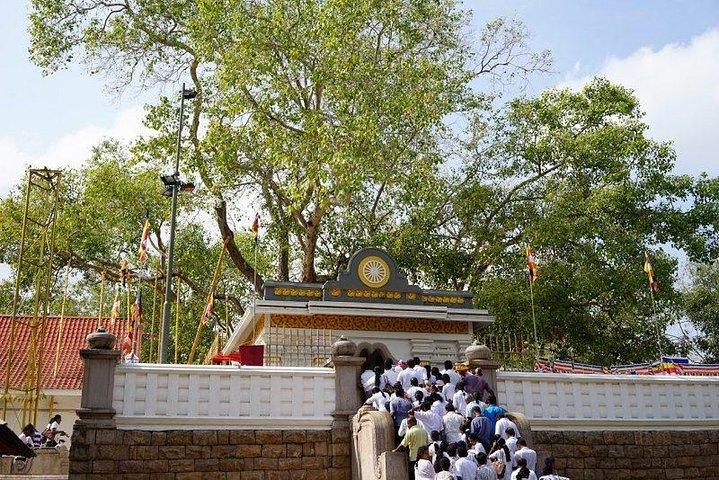
The Jaya Sri Maha Bodhi is a sacred Bo tree, or Ficus religiosa, that stands in the Mahamewna Gardens in Anuradhapura, Sri Lanka. Not only is it the closest authentic living link to Gautama Buddha, it is also the oldest human-planted tree in the world with a known planting date and a recorded history. About 2,600 years ago, Lord Gautama Buddha sat with his back against an Esathu tree on the banks of the Neranjana River in Bodhgaya, India. It was at this moment, as he sat against the tree, that the Buddha is said to have achieved enlightenment. In doing so, the tree also gained a venerated status. It became known as the Bodhi tree, and pilgrims came to see it even within the lifetime of the Buddha. Later, in 236 BC, the Buddhist nun Sanghamitta Maha Theri was sent by Emperor Asoka from India to Sri Lanka. With her, she carried a southern branch of the original sacred fig. one of the earliest kings of Sri Lanka whose reign was notable for the arrival of Buddhism. In 288 BC,
Lovamahapaya is a building situated between Ruwanweliseya and Sri Mahabodiya in the ancient city of Anuradhapura, Sri Lanka. It is also known as the Brazen Palace or Lohaprasadaya because the roof was covered with bronze tiles. In ancient times, the building included the refectory and the uposathagara (Uposatha house). There was also a Simamalake where the Sangha assembled on Poya days to recite the sutra of the confessional. The famous Lohaprasada built by King Dutugemunu, described as an edifice of nine stories, was a building of this class. One side of the building was 400 ft (120 m) in length. There are 40 rows, each row consisting of 40 stone pillars, for a total of 1600 pillars. It is said that Lovamahapaya was adorned with corals and precious stones. It is believed that it took six years for the construction of the building and the plan was brought from the heavens. The building was completely destroyed during the reign of King Saddhatissa.
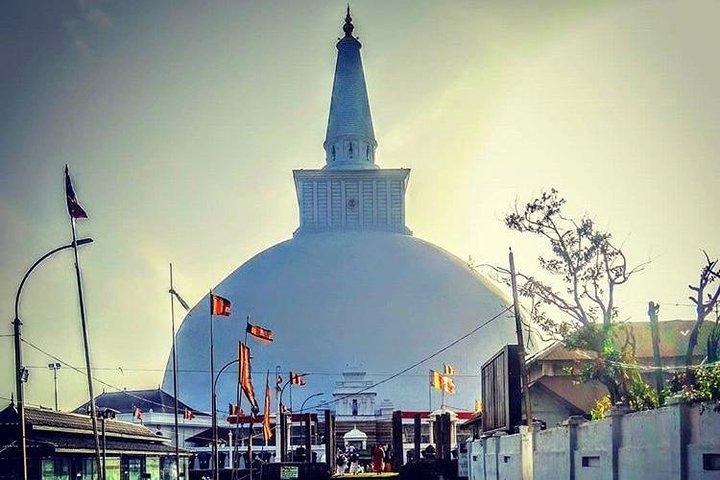
The Ruwanweli Maha Seya, also known as the Mahathupa (the Great Thupa) is a stupa (a hemispherical structure containing relics) in Anuradhapura, Sri Lanka. Two quarts or one Dona of the Buddha's relics are enshrined in the stupa, making it the largest collection of his relics anywhere.[1] It was built by Sinhalese King Dutugemunu in c. 140 B.C., who became king of Sri Lanka after a war in which the Chola King Elāra (Ellalan) was defeated. It is also known as Swarnamali Seya, Svaṇṇamāli Mahaceti (in Pali) and Rathnamali Seya.
The Jetavanarama stupa or Jetavanaramaya (Sinhala: ජේතවනාරාමය, romanized: jētavanārāmaya) is a stupa, or Buddhist reliquary monument, located in the ruins of Jetavana monastery in the UNESCO world heritage city of Anuradhapura,[2] Sri Lanka. At 122 metres (400 ft), and was the world's tallest stupa;[3] and the third tallest structure in the world[4] when it was built by King Mahasena of Anuradhapura (273–301). He initiated the construction of the stupa[5]: 49 following the destruction of the Mahaviharaya of Anuradhapura. His son Maghavanna I completed the construction of the stupa, and was renovated by Parakramabahu I of Polonnaruwa.[6] A part of a sash or belt tied by the Buddha is believed to be the relic that is enshrined here.
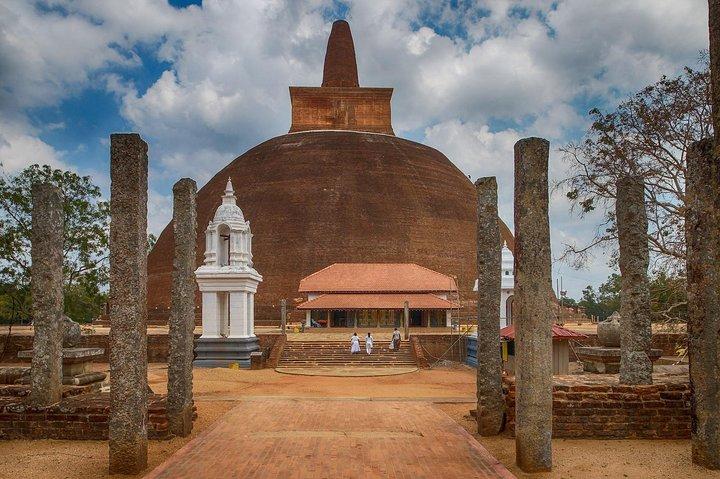
Abhayagiri Vihāra was a major monastery site of Mahayana, Theravada and Vajrayana Buddhism that was situated in Anuradhapura, Sri Lanka. It is one of the most extensive ruins in the world and one of the most sacred Buddhist pilgrimage cities in the nation. Historically it was a great monastic centre as well as a royal capital, with magnificent monasteries rising to many stories, roofed with gilt bronze or tiles of burnt clay glazed in brilliant colors. To the north of the city, encircled by great walls and containing elaborate bathing ponds, carved balustrades and moonstones, stood "Abhayagiri", one of seventeen such religious units in Anuradhapura and the largest of its five major viharas. One of the focal points of the complex is an ancient stupa, the Abhayagiri Dagaba. Surrounding the humped dagaba, Abhayagiri Vihara was a seat of the Northern Monastery, or Uttara Vihara and the original custodian of the Tooth relic in the island.
Thuparamaya is the first Buddhist temple that was constructed, after the arrival of mahinda thero(mahindagamanaya) in Sri Lanka. Located in the sacred area of Mahamewna park, the Thuparamaya Stupa is the earliest Dagoba to be constructed in the island, dating back to the reign of King Devanampiya Tissa (247-207 BC).[1] The temple has been formally recognised by the Government as an archaeological site in Sri Lanka.[2]
The Samadhi Buddha is a famous statue situated at Mahamevnāwa Park in Anuradhapura, Sri Lanka. The Buddha is depicted in the position of the Dhyana Mudra, the posture of meditation associated with his first Enlightenment. This statue is 7 feet 3 inches in height and carved from dolomite marble.[citation needed]. It is similar to the Toluvila statue from the same period. It is similar to Gupta period Buddha images, it is believed that originally the image was gilded and had inlaid eyes[1] made of precious gems.[2] It is likely that it was one of the four statues around a sacred Bodhi tree shrine. This is the only one that has survived largely intact
The ancient Meghagiri Vihara or Meygiri Vihara is presently identified as the Isurumuni Vihara.[1] It was built by King Devanampiya Tissa (307 BC to 267 BC) who ruled in the ancient Sri Lankan capital of Anuradhapura.[2] After 500 children of high-caste were ordained, Isurumuniya was built for them to reside.[2] King Kasyapa I (473-491 AD) again renovated this viharaya and named it as "Boupulvan, Kasubgiri Radmaha Vehera" giving the names of his 2 daughters and his name.[3] There is a viharaya connected to a cave and above is a cliff. A small stupa is built on it. It can be seen that the constructional work of this stupa belongs to the present period. Lower down on both sides of a cleft, in a rock that appears to rise out of a pool, have been carved the figures of elephants. On the rock is carved the figure of a horse. The carving of Isurumuniya lovers on the slab has been brought from another place and placed it there. A few yards away from this vihara is the
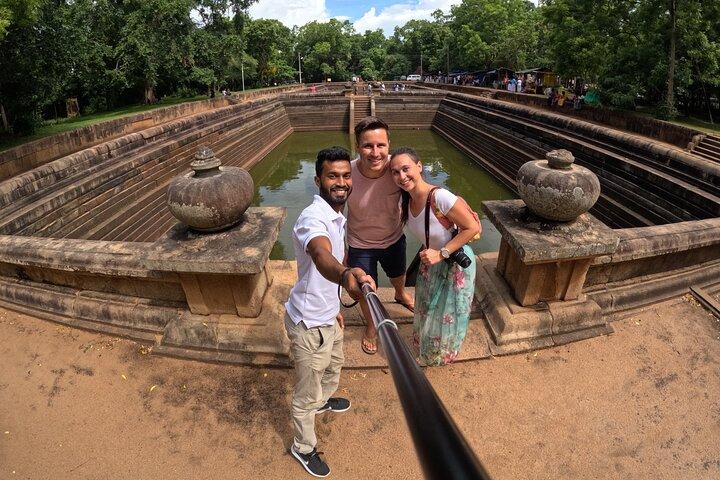
Kuttam Pokuna (twin ponds or pools) are well preserved old bathing tanks or ponds in Sri Lanka. This pair of ponds was built by the Sinhalese in the ancient Anuradhapura Kingdom. They form part of the Abhayagiri vihāra complex and are an example of the achievements in the field of hydrological engineering, architecture and art of the ancient Sinhalese.
Vessagiriya, or Issarasamanarama, is an ancient Buddhist forest monastery that is part of the ruins of Anuradhapura, one of the ancient capitals of Sri Lanka. It is located about half a mile south of Isurumuniya, among boulders. Begun in the reign of King Devanampiya Tissa (mid-3rd century BC), the site was expanded during the reign of King Kasyapa (473 - 491 AD) to become home to about five hundred monks.
Sandakada pahana, also known as Moon-stone, is a unique feature of the Sinhalese architecture of ancient Sri Lanka.[1][2][3] It is an elaborately carved semi-circular stone slab, usually placed at the bottom of staircases and entrances. First seen in the latter stage of the Anuradhapura period, the sandakada pahana evolved through the Polonnaruwa, Gampola and Kandy period. According to historians, the sandakada pahana symbolises the cycle of Sansāra in Buddhism
Highlights
What's included
Pickup Locations & Times
I’ll pickup visitors from there hotel. (Any location)
Traveller Ratings
Important Information
- Wheelchair accessible
- Public transportation options are available nearby
- Infants are required to sit on an adult’s lap
- Specialized infant seats are available
- Suitable for all physical fitness levels
Reviews(24)
Good guide who explains a lot of interesting things, but does not overload you with information. We loved that. He responded to our wishes. Great: he speaks really good English! We understood everything. For the means of transport is paid separately
Very nice and interesting tour. Lampa knew with great enthusiasm very clearly and a lot about the city and Buddhism within Sri Lanka. Absolutely recommended.
We had a brilliant morning tour. Our guide was super knowledgeable, and we visited all the sites.. I would definitely recommend it We are solo travellers, and we learnt a lot from our guide.
Expensive driver + expensive lunch (which we also payed his). We didn't get to see the paying sites, although we payed him to buy us tickets. We think he never bought the tickets en kept the money to himself. Although we learned a lot about Anuradhapura and Buddhism, this doesn't outweigh the way we feel treated. Just be cautious when you book him.
Lampa took us to both the key Sacred City sites of Anuradhapura and to Mittinhale. He was always prompt, knowledgeable and entertaining. Even in the pouring rain! Highly recommended.
My friend and I did a two half a day tours with Lampa. We had a great time. He explained everything about the history and culture of Sri Lanka very well and was great fun too! Would 100% recommend
Had a super nice two day tour with Lampa . He explained everything about the tempels and other facts about Sri Lanka perfectly and was fun as well. Would 100% recommend!
We knew about Lampa in our hotel. We did the half day tour in Anuradapura. Really good time discovering the important places in Anuradapura and learning from Lampa. We really recommend Lampa as guide in the Sacred city. Thank you Lampa.
Thank you so much Madam for sharing your experience! and thank you so much!🥰
Lampa’s tour is the best activity to do in Anduradaphura. Frist of all, Lampa’s English is really good. He tells great stories about the city, it’s history, and about buddhism. We went for a full day, starting in Andurahapura and finishing in Minthale. We could easily communicate about the pick-up place and the things we wanted to see during our tour. I highly recommend Lampa’s tour.
We did the tour with Lampa and it definitely outdid our expectations!! Lampa was the best possible tour guide we could have wished for: he explained everything in a lot of detail, was enthusiastic, spoke very very good English and answered all our questions. By throwing back questions at us he quizzed the things he said so we could remember it more, which made it more fun. He had so much knowlegde about the history of buddism and Sri Lanka in general and told it in a fun and understandable way. The price may be higher than other tour guides offer but Lampa is an official licenced tour guide who studied for this job and tells so much more than the cheaper opties who would just walk along without explaining more details about the sights and history of the buddism. I would 100% recommend booking this tour with him if you are staying in Anuradhapura, looking to immerse yourself in the history of buddhism and support a hardworking man at the same time! Thank you again Lampa, it was unforgetable today and we loved it!
Your feedback means a lot and encourages me to keep providing the best experience possible. Thank you again for choosing my tour, and I hope to see you again in the future! 🥰